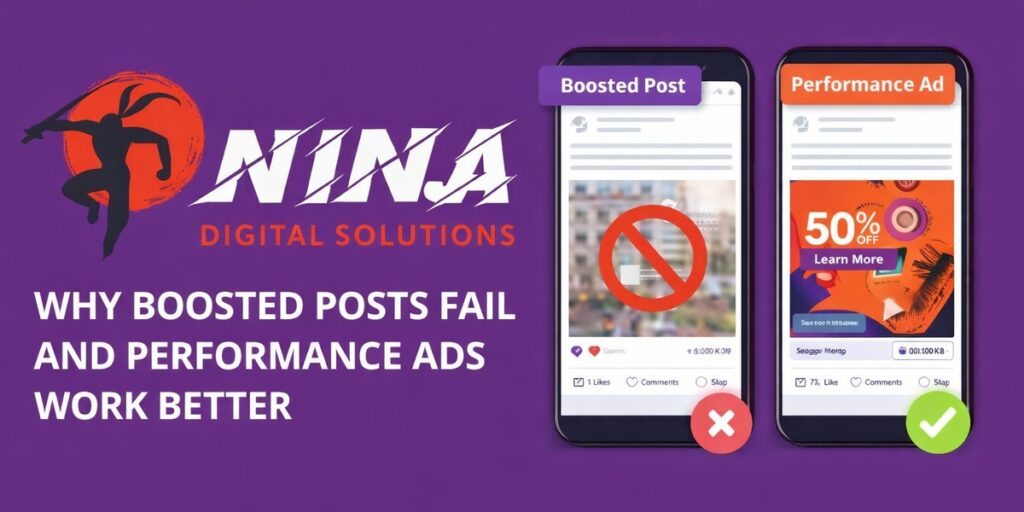
Why Boosted Posts Fail and Performance Ads Work Better
In the world of digital marketing, there is a “siren song” that captures the attention of every busy business owner: the blue Boost Post button. It sits right there under your content, promising more reach, more eyes, and more “success” for just a few dollars a day.
For a startup or a digital marketer under pressure, it feels like a shortcut to growth. However, there is a reason professional media buyers rarely touch that button. While boosting a post feels productive, it is often the quickest way to burn through a marketing budget with nothing to show for it but “likes” that don’t pay the bills.
If you want to move from spending money to investing it, you need to understand why boosted posts fail and why Performance Ads are the true engine of business scalability.
The “Boost Post” Illusion: Why Simplicity is Costly
The “Boost Post” button was designed for convenience, not for ROI. It is a simplified version of the Meta advertising ecosystem, and in that simplification, the most powerful tools are stripped away.
Limited Objectives and “Cheap” Engagement
When you boost a post, Meta’s algorithm has one primary goal: Engagement. It looks for people in your target audience who are likely to “Like,” comment, or share.
The problem? “Likers” are rarely “Buyers.” By optimizing for engagement, you are telling the platform you want social proof, not sales. You might get 500 likes for $50, but if zero of those people visit your checkout page, your ROI is effectively zero.
Lack of Precision Targeting
While boosting allows for basic demographic selection, age, gender, and location—it ignores the “secret sauce” of modern digital marketing: Lookalike Audiences and Custom Retargeting.
Performance Ads allow you to target people who have specifically spent more than 30 seconds on your pricing page or people who “look” exactly like your top 1% of customers. Boosting is a shotgun approach; Performance Ads are a sniper rifle.
Zero Control Over Placements
A boosted post usually defaults to the Facebook or Instagram News Feed. However, some of the highest-converting real estate today lives in Reels, Stories, and Search results. Without the ability to manually select or optimize placements, your ad might appear in low-quality areas where users are mindlessly scrolling and have no intention of clicking away.
The Performance Ad Advantage: Precision Over Popularity
Performance Ads, managed through the Meta Ads Manager, operate on a completely different logic. They are designed to align with your specific business goals, whether that is lead generation, app installs, or e-commerce sales.
Advanced Optimization for Business Outcomes
Performance Ads use the Meta Pixel and Conversions API to track actual behavior. If your goal is “Conversions,” the algorithm doesn’t just look for people who like photos; it looks for people who have a historical habit of clicking “Buy Now.” You aren’t just buying impressions; you are buying intent.
A/B Testing: The Secret to Scalability
One of the biggest reasons boosted posts fail is that you are betting everything on a single creative. Performance Ads allow for Split Testing (A/B Testing). You can test:
- Two different headlines.
- A video vs. a static image.
- Two different “Calls to Action” (e.g., “Shop Now” vs. “Get Offer”).
By identifying the winner early, you can kill the underperforming ads and scale the ones that are actually generating a profit.
Read – How Businesses Turn Social Media Engagement into Real Sales
Performance Ads vs. Boosted Posts: At a Glance
| Feature | Boosted Posts | Performance Ads (Ads Manager) |
| Primary Goal | Awareness & Engagement | Leads, Sales, & ROI |
| Targeting | Basic Interests | Advanced Lookalikes & Retargeting |
| Creative Control | Limited to existing posts | Carousels, Collections, & Dynamic Creative |
| A/B Testing | Non-existent | Built-in Testing Suites |
| Funnel Strategy | Top of Funnel only | Full Funnel (Awareness to Sale) |
Strategic Advice for Startups and Digital Marketers
Does this mean you should never boost a post? Not necessarily. But you must use it as a tool, not a strategy.
When Should You Actually Boost a Post?
Boosting is effective for Social Proof. If you have a major announcement or a high-quality piece of educational content, boosting it can build “authority” by increasing the visible engagement. It makes your page look “alive” to potential customers who visit your profile.
Transitioning to Ads Manager: The First 3 Steps
- Install the Pixel: You cannot manage what you do not measure. Ensure your website is tracking events like “Add to Cart” or “Lead Form Submit.”
- Define Your North Star Metric: Stop reporting on “Reach.” Start reporting on Cost Per Acquisition (CPA) or Return on Ad Spend (ROAS).
- Build a Funnel: Don’t just ask for a sale on the first touchpoint. Use Performance Ads to warm up an audience with a video, then retarget those viewers with a specific offer.
Conclusion: Stop Boosting, Start Scaling
The difference between a “Boosted Post” and a “Performance Ad” is the difference between vanity and victory. For startups and business owners, every dollar counts. Spending money on “likes” is a luxury most cannot afford.
By moving your budget into a structured Performance Ad strategy, you gain access to the full power of machine learning, precision targeting, and data-driven scaling. It’s time to stop shouting into the void and start speaking directly to the people ready to buy.